
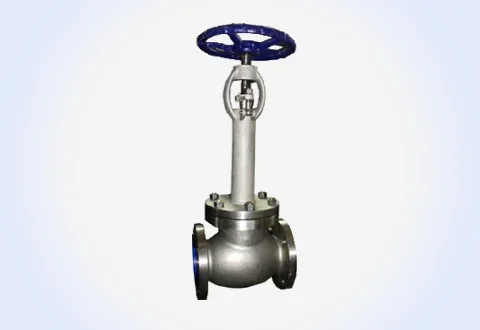
A Cryogenic Globe Valve is a type of valve specifically designed to operate in very low-temperature environments, typically below -150°C (-238°F), such as those used in the storage and transport of liquefied gases like LNG (Liquefied Natural Gas), Liquid Oxygen, Liquid Nitrogen, or Liquid Hydrogen.
 Key Features of Cryogenic Globe Valves:
Material Compatibility:
Made from stainless steel or other materials that remain ductile at cryogenic temperatures.
Designed to prevent brittle failure due to extreme cold.
Extended Bonnet Design:
Includes an extended bonnet to keep the packing gland away from the cryogenic fluid, reducing the risk of frost damage and ensuring proper stem sealing.
This helps maintain valve operability and reduces ice formation on the stem.
Tight Shut-Off:
Designed for bubble-tight shutoff to prevent leakage of hazardous or expensive cryogenic gases.
Low Emission Packing:
Ensures minimal leakage through the stem, which is critical in cryogenic applications due to environmental and safety concerns.
Flow Control:
The globe valve design is ideal for precise throttling and flow control, making it suitable for regulating cryogenic media.
 Applications:
LNG plants and carriers
Cryogenic storage tanks
Aerospace fueling systems
Industrial gas processing
Medical gas systems (e.g., liquid oxygen)
 Advantages:
Precise flow regulation
Suitable for low-temperature applications
Extended service life when used properly
 Disadvantages:
Higher pressure drop compared to ball or gate valves
More expensive than standard globe valves due to specialized materials and design
Would you like help selecting a specific model or comparing manufacturers?
Here’s a detailed sectional diagram of a cryogenic globe valve—showing its extended bonnet, stem, body, disc, seals, and other critical components.
Cryogenic Globe Valve with Datasheet– Details & Examples
1. Cryogenic Globe Valve (Type 01741)
This valve exemplifies a field-ready, specification-rich cryogenic globe valve:
Size & Pressure: DN 80 (3″), PN 50 (max differential pressure 50 bar)
Temperature Range: –255 °C to +120 °C
Materials:
Body: Stainless Steel CF3M (1.4409)
Trim: Stainless Steel 316L (1.4404)
Seating: Soft seat made of PCTFE; sealing via graphite/PTFE packing
Performance:
Tight shutoff: Leakage Class Rate A (EN 12266‑1)
Kvs = 104 m³/h, Cv = 121.3 gpm
Design: Manual operation, quick‑opening characteristic, oxygen‑cleaned for safe use with hazardous gases
Datasheet: provides a downloadable PDF with detailed specifications, dimensions, and materials
2. QASWA Cryogenic Globe Valve
Engineered for precision control at temperatures as low as –196 °C, this valve offers:
Standards: Compliant with BS 6364, ASME B16.34, API 602
Size: DN 15–300 (½″–12″)
Pressure Rating: ANSI 150–900 / PN 10–160
Materials: Stainless Steel (CF8M, CF3M), Monel, Inconel, Duplex
Trim Options: Stellite®, PCTFE, metal‑to‑metal seating
Features:
Extended bonnet for stem protection
Bubble‑tight sealing (API 598, Class IV or VI)
Versions cleaned for oxygen service
This design is ideal for LNG, liquid oxygen/nitrogen, and aerospace fueling systems.
3. QASWA Control Cryogenic Globe Valve
Robustly built for ultra-low temperatures, with:
Materials: Forged body, vacuum‑insulated cover
Sealing: Bellows option ensures absolute tightness; self‑lubricating bearings for smooth operation
Standards: Meets BS 6364
Specifications: NPS ½–24 (DN 15–600), Class 150–2500 / PN 10–420, temperature –196 °C to +150 °C
4. QASWA Cryogenic Globe Valve
Designed for high reliability with:
Stem Design: Loose flange bolted bonnet to accommodate thermal expansion
Materials: Bronze, stainless steel (optional bronze internals)
Sizes & Ratings: DN 6–200; up to 50 bar; temperature down to –196 °C
Notable Features: Anti‑blowout stem, revolving disc for wear distribution, oxygen‑cleaned options
Media: Hydrogen, nitrogen, oxygen, argon, CO₂, natural gas, and more
5. QASWA API‑602 Cryogenic Globe Valve
Compact, reliable, and clean:
Standards: API 602 forged steel globe valves adapted for cryogenic service
Additions:
Extended bonnets for thermal protection
Solid CoCr alloy wedges (no galling)
Optional Kel‑F inserts for disc sealing
Oxygen-cleaned and degreased ends
Sizes: NPS ¼–2 (DN 8–50)
Pressure Class: ASME 150–2500
Summary Comparison Table
| Manufacturer / Type | Size Range | Temp Range | Materials & Seals | Special Features |
|---|---|---|---|---|
| Herose Type 01741 | DN 80 (3″) | –255 °C to +120 °C | CF3M body, PCTFE seating, graphite/PTFE seal | Quick open, oxygen-cleaned, tight shutoff |
| FCT | DN 15–300 | down to –196 °C | Various steels/alloys; Stellite or PCTFE | Extended bonnet, bubble-tight sealing |
| RAYS Flow Control | DN 15–600 | –196 °C to +150 °C | Forged body, vacuum cover | Bellows seal option, self-lubricating |
| Parker Bestobell | DN 6–200 | –196 °C up | Bronze/SS body, PCTFE/PTFE parts | Loose flange bonnet, oxygen-cleaned |
| Velan API‑602 | DN 8–50 | Cryogenic | Forged steel, CoCr wedge | Compact API‑602, optional Kel‑F inserts |
Where to Access Datasheets & Further Specs
QASW 01741 Datasheet: Download via Ramén Valves site with full specs, drawings, and materials.
Manufacturer Sites (QASWA ) typically offer datasheet downloads or spec details upon request.
Supply Partners: In India ( India), valves are represented and can assist with inquiries, datasheets, or custom requests
What Next?
Would you like help selecting a valve for a specific application (e.g., LNG tank, oxygen pipeline)?
I can assist in comparing models for size, pressure, sealing, or temperature needs.
Need assistance downloading or interpreting a datasheet? Let me know — I can guide you through it.
Happy to help!